 |
| Yixing clay teapots in the V & A Museum |
The clay has been extracted in the Jiangsu province since at least the Song dynasty, one thousand years ago. Some of the old sources of the clay are worked out, making new teapots scarce and expensive. I understand that it is no longer possible to export old teapots from China as belatedly, the government has decided to preserve the cultural history of this ancient and complex land.
Teapots come in a variety of shapes and sizes, although most are smaller than Western style teapots. Some are highly decorated and formal, while others reflect popular themes and whimsical characters.
I like miniature teasets which is why I bought this one - teapot lid on teapot:


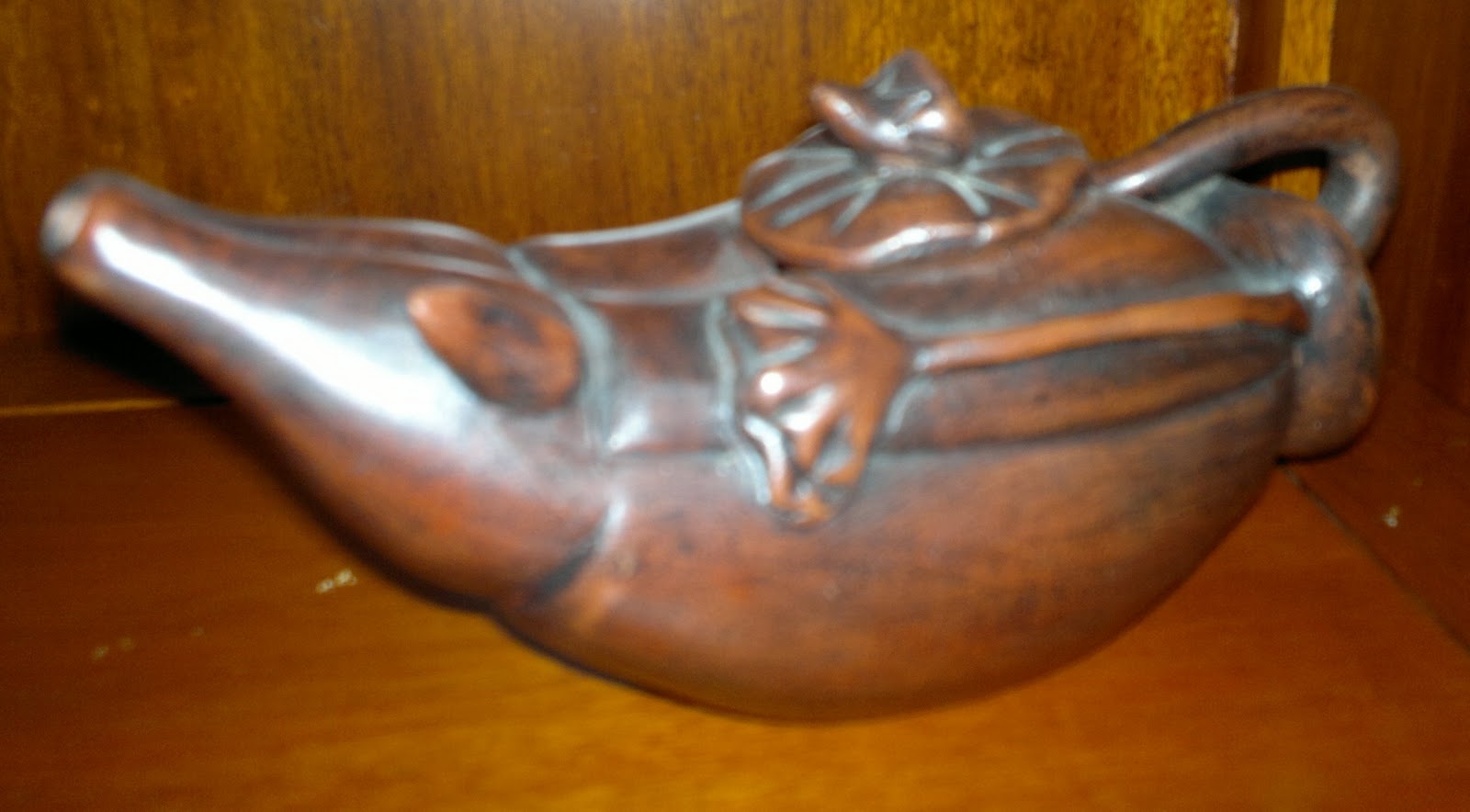
This one is in the form of a lotus root. Lotus flowers are important in Buddhist iconography:
Symbols representing good luck, wisdom and wealth are common in all sorts of Chinese artefacts, fabrics and furniture. Wise men and Bodhavistas (holy beings who have attained enlightenment but remain amongst the living to assist them on their paths) are also common images. This teapot cradles one of the Wise Men - Fu Lu Shou - who is supposed to bring wealth and propserity to the owner.

I suspect there would have been a set of three teapots originally, each representing one of the Fu Lu Shou attributes (Good Fortune, Prosperity and Longevity). He is holding a golden ingot or yuan bao, to encourage wealth or good fortune. Some representations of the Fu Lu Shou combine the three attributes of the Wise Men into one figure.
This little piggy is my favourite:

The pig is associated with fertility and virility in the twelve-year Chinese Zodiac. Possibly this chap was one of a set of twelve, or may have been the property of a person born in the 'Year of the Pig'. I love his fat cheeks and devil-may-care attitude.
Ready for a cuppa?
x

